

How to Compare Hard Money Loan Rates Without a Credit Pull
Shopping for a hard money loan usually means fielding calls from dozens of lenders, each one wanting to run your credit before quoting a rate. That process dings your score and wastes your time. The good news: you can compare hard money loan rates without triggering a single hard inquiry. Platforms like Lendersa let you view offers from hundreds of lenders using only property and deal details, with no Social Security number required to start. This guide walks you through exactly how to do it, why it matters, and what to watch for along the way.
What Is a Hard Money Loan?
A hard money loan is a short-term, asset-based financing option provided by private investors or specialty lending firms rather than traditional banks. These loans typically carry terms of 6 to 36 months and are secured by the property itself rather than the borrower's income or credit profile.
Hard money loans are most commonly used for fix-and-flip projects, bridge financing, and commercial real estate acquisitions where speed matters more than getting the absolute lowest rate. According to industry data from Gelt Financial, approval timelines run 3 to 5 days compared to 30 to 45 days for conventional financing.
Soft Pull vs. Hard Pull: Why It Matters
A soft credit pull is a credit check that does not affect your credit score and is typically used for prequalification or informational purposes. A hard credit pull is a formal inquiry tied to a credit application that can temporarily lower your score by a few points, according to Experian.
When you shop multiple lenders the traditional way, each hard inquiry stacks up. While FICO offers a rate-shopping window of about 45 days for mortgages, hard money loans do not always qualify for this exemption. That means five lender applications could equal five separate dings on your report.
Why Borrowers Should Care
Multiple hard inquiries signal risk to future lenders and can push your score down right when you need it most. Platforms that use soft pulls or no credit check at all let you gather competitive quotes without that downside.
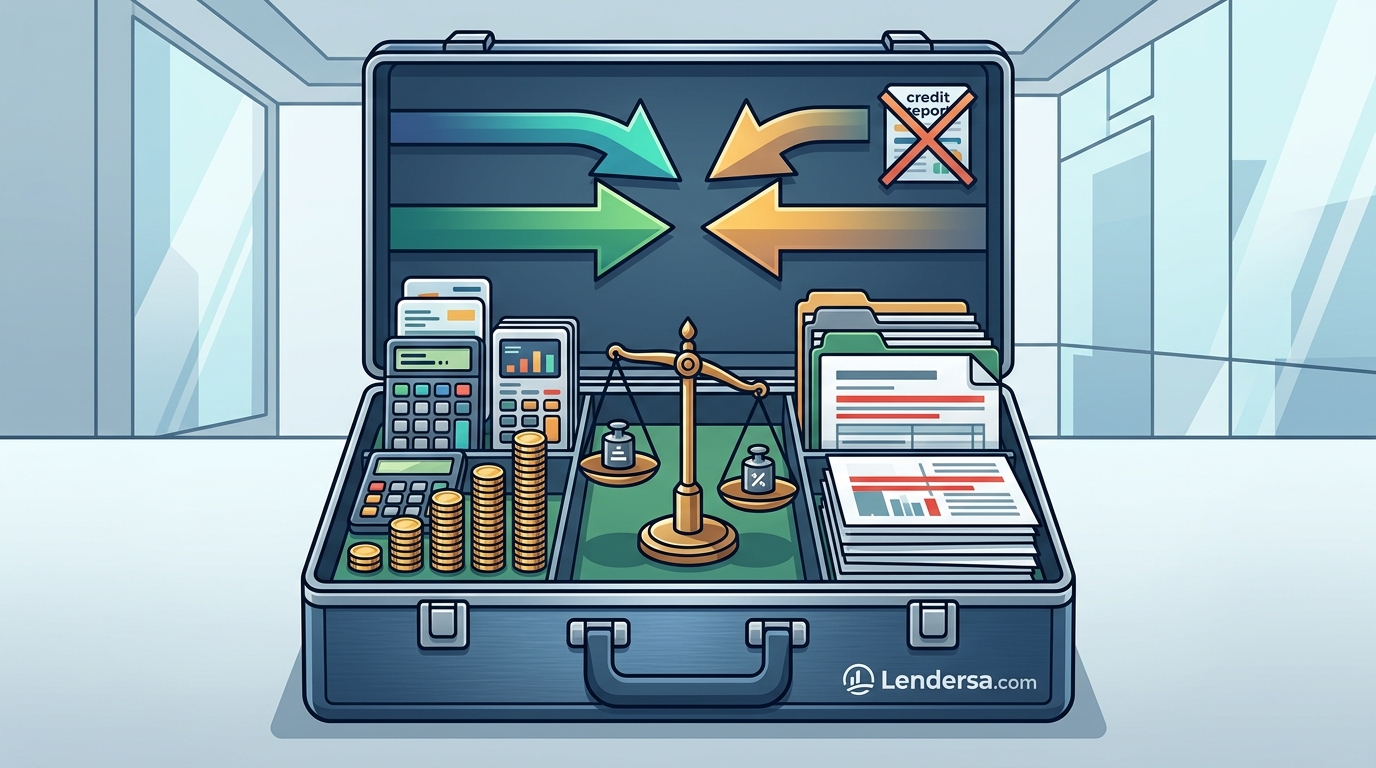
Step-by-Step: Compare Rates Without a Credit Pull
1. Use an AI Loan Marketplace
Start with a platform that matches your deal to lenders without requiring your SSN. Lendersa's AI matching engine compares your scenario against 500+ lender criteria and returns ranked results instantly. Your contact information stays private until you choose a lender to engage.
2. Provide Property and Deal Details
Instead of personal financial data, focus on the property value, loan amount, property type, and intended use (purchase, refinance, fix-and-flip). The Lendersa Optimization Engine analyzes over 20 data points against lender underwriting guidelines to surface the best-fit programs.
3. Review and Compare Term Sheets
Once matched, review competing term sheets side by side. Pay attention to the interest rate, origination points, loan-to-value ratio, prepayment penalties, and closing timeline. Use Lendersa's lender directory to sort results by rate, LTV, or speed of funding to find the right balance for your project.
What Hard Money Lenders Actually Look At
Hard money underwriting is fundamentally different from conventional lending. Rather than scrutinizing your FICO score and debt-to-income ratio, most hard money lenders use property-focused underwriting. They evaluate the real estate investment itself, including the property's current value, after-repair value (ARV), and the borrower's exit strategy.
Some lenders may still perform a soft pull as part of their due diligence, but it is not a gating factor for approval. A borrower with a low credit score and a solid property at 65% LTV will typically get funded before a borrower with an 800 score and a weak deal.
This asset-first approach is exactly why you can compare rates without a formal credit pull. The property is the collateral, and the deal structure drives the pricing.
Key Factors That Affect Your Hard Money Rate
Even without a credit check, several variables determine the rate you will be offered:
- Loan-to-Value (LTV) Ratio: Most hard money lenders offer LTVs between 65% and 75%. A lower LTV generally means a lower rate because the lender's risk is reduced.
- Property Type: Residential single-family homes often carry lower rates than raw land or commercial properties.
- Borrower Experience: Repeat investors with a track record of successful projects can negotiate better terms.
- Loan Term: Shorter terms (6 to 12 months) may carry different rate structures than longer terms (up to 36 months).
- Market Conditions: Regional demand and the broader interest-rate environment influence hard money pricing.
Understanding these factors helps you adjust your loan request to unlock better offers. The LoanImprove tools on Lendersa can suggest small changes, like adjusting your loan amount by just 1%, that may shift your results from denied to approved or lower your rate.
Hard Money vs. Conventional Loans: Quick Comparison
| Feature | Hard Money Loan | Conventional Loan |
|---|---|---|
| Interest Rate | 10% – 18% (varies by deal) | 6% – 8% (varies by credit) |
| Approval Speed | 3 – 14 days | 30 – 60 days |
| Credit Check Required? | Often no; soft pull at most | Yes, hard pull required |
| Primary Approval Factor | Property value & LTV | Credit score & income |
| Typical Loan Term | 6 – 36 months | 15 – 30 years |
| Down Payment | 20% – 35% | 3% – 20% |
| Origination Fees | 1% – 5% (points) | 0.5% – 1% |
| Best For | Fix-and-flip, bridge, fast close | Long-term ownership |
This table highlights why hard money is the faster, more flexible path for investors who need to move quickly or cannot meet traditional underwriting standards. For a deeper comparison tailored to your scenario, try the Lendersa AI matching tool.
Key Takeaways
- You can compare hard money loan rates without a hard credit pull by using AI-powered loan marketplaces like Lendersa.
- A soft credit pull does not affect your credit score, while a hard pull can lower it by several points.
- Hard money lenders primarily evaluate the property's value and LTV ratio, not your FICO score.
- Typical hard money rates range from 10% to 18%, with approval in as little as 3 to 14 days.
- Adjusting deal variables like loan amount or LTV by small margins can significantly improve your rate offers.
- Always compare the full cost of capital, including origination fees and prepayment penalties, not just the headline rate.
- Your contact information stays private on Lendersa until you select a lender to work with.
Frequently Asked Questions
Can I really compare hard money rates without giving my Social Security number?
Yes. Platforms like Lendersa allow you to input property and deal details to receive matched lender offers without requiring your SSN or triggering any credit inquiry.
What is the difference between a soft pull and a hard pull?
A soft pull is a credit review that does not impact your score and is used for prequalification. A hard pull is a formal credit inquiry tied to a loan application that can temporarily lower your score by a few points.
Do hard money lenders check credit at all?
Some hard money lenders perform a soft credit pull as part of due diligence, but credit score is not the primary approval factor. The property's value, LTV, and your exit strategy carry far more weight.
What credit score do I need for a hard money loan?
Most hard money lenders do not set a minimum credit score requirement. Borrowers with scores ranging from the low 500s to 800+ have been funded based on the strength of their deal and collateral.
How fast can I close a hard money loan?
Many hard money lenders close in 7 to 14 days. Some direct lenders can fund in as few as 3 to 5 days, compared to 30 to 60 days for conventional financing.
What are typical hard money loan rates in 2026?
Hard money interest rates in 2026 generally start at around 10% to 12% and can reach 18% or higher depending on LTV, property type, borrower experience, and lender risk appetite.
Will comparing rates from multiple lenders hurt my credit?
Not if you use a marketplace that relies on soft pulls or no credit inquiry. Shopping through Lendersa, for example, creates zero hard inquiries on your credit report.
What documents do I need to compare hard money rates?
At the comparison stage, you typically only need basic property information: address or location, estimated value, desired loan amount, and intended use. No tax returns, W-2s, or income verification are required to get started.
Compare Hard Money Rates on Lendersa Today
Stop calling lenders one by one and letting each one pull your credit. Visit Lendersa.com to instantly compare offers from hundreds of hard money lenders and banks, with no SSN required and no impact on your credit score. Enter your property details, review competing term sheets, and choose the deal that fits your project. Your next investment is waiting.