

How to Compare Hard Money Loan Rates Without a Credit Pull
Shopping for a hard money loan should not cost you credit score points before you even receive a quote. A hard credit inquiry is a formal request by a lender to review your full credit report, and it can temporarily lower your score by 3 to 5 points. Fortunately, several platforms and lenders now let you compare rates using only soft inquiries or no credit check at all. Below, you will learn exactly how to evaluate hard money loan rates, protect your credit, and find the best deal using tools like the Lendersa Advanced Calculator, all without handing over your Social Security number.
Soft Pull vs. Hard Pull: Why It Matters
A soft credit pull is a credit check that has no impact on your credit score. Lenders use soft pulls to pre-qualify you for loans and evaluate your creditworthiness without triggering a formal inquiry. A hard credit pull, on the other hand, is a full review of your credit history that occurs when you formally apply for a loan and can remain on your report for up to two years.
For borrowers exploring multiple lenders, each unnecessary hard inquiry adds up. That is why starting with platforms that offer soft-pull or no-pull comparisons is critical. Lendersa lets you get preapproved for your equity-based loan without providing your Social Security number or any sensitive financial information.
How Hard Money Loan Pricing Works
A hard money loan is a loan secured by real estate and originated by private investors or portfolio lenders, with approval based primarily on the ratio between the loan amount and the property's market value. Unlike conventional mortgages, hard money lenders focus on the equity left in the property rather than your income or employment history.
Current hard money interest rates typically range from 9.5% to 12% for first-position loans, according to North Coast Financial's 2026 rate data. Origination fees, often called points, add another 1% to 5% of the loan amount. Because these costs vary widely between lenders, comparing multiple offers is essential to controlling your total cost of capital.
Hard-Hard vs. Soft-Hard vs. Non-QM
Hard money programs break into three main categories. Hard-hard money (HH) lenders approve loans up to 55%-65% LTV regardless of credit. Soft-hard money (SH) lenders consider credit and can offer higher LTVs of 70%-75%. Non-QM lenders underwrite using bank statements or assets, often providing the lowest rates in the private lending space. Lendersa's calculator automatically checks your eligibility across all three categories with a single request.
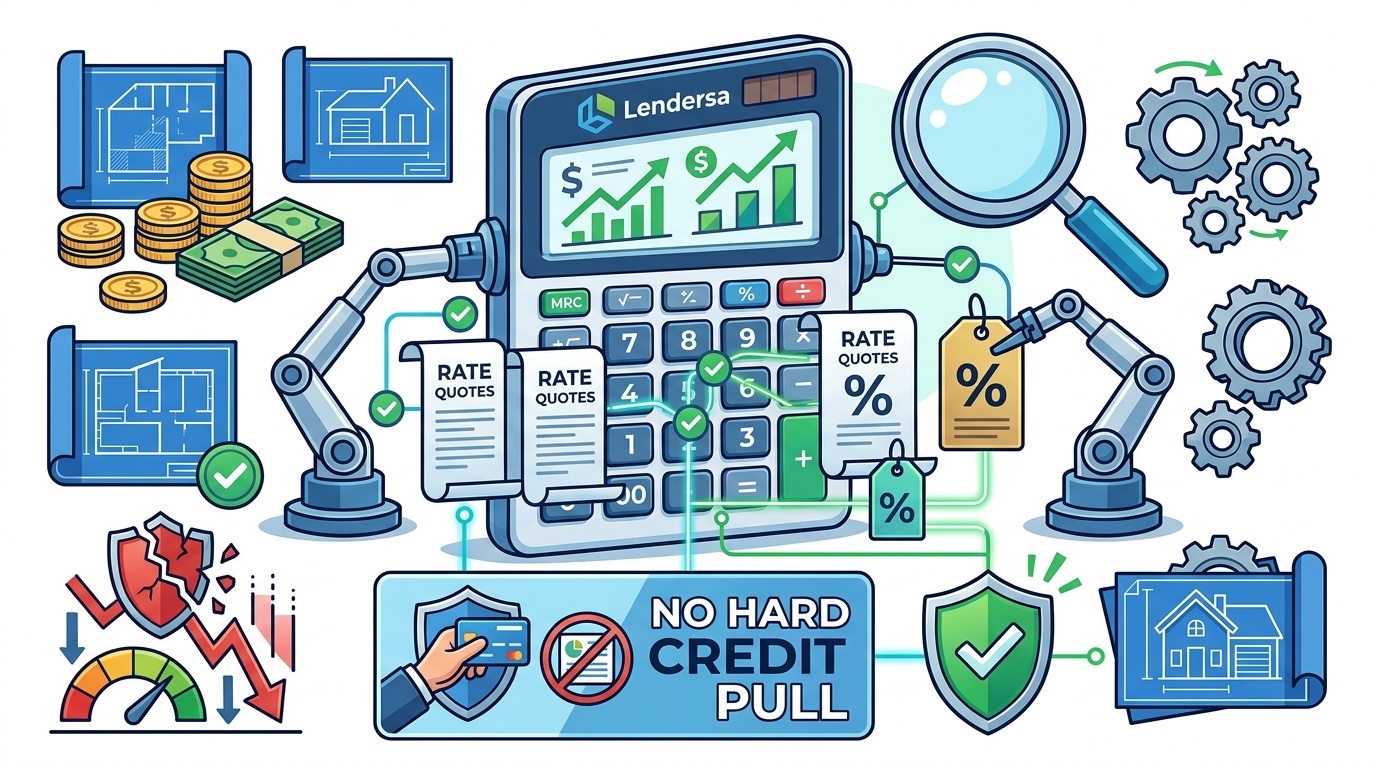
Step-by-Step: Compare Rates Without a Credit Pull
1. Use an AI-Powered Loan Calculator
Start with the Lendersa hard money calculator, which evaluates your scenario against thousands of loan programs using over 15 factors. Enter your property type, zip code, estimated value, and desired loan amount. No SSN is required, and the tool returns rate and term estimates in under 60 seconds.
2. Submit a Loan Request, Not an Application
A loan request is not a loan application. Lendersa's platform lets you broadcast your deal to multiple matching lenders without triggering a credit pull. You provide non-confidential financial details, and 3 to 6 of the best-matching lenders compete for your loan with real proposals.
3. Review, Negotiate, Then Apply
Once you have competing offers on your personalized dashboard, compare the interest rate, points, term length, and prepayment penalties side by side. Only after you select a lender do you move to a formal application that may involve a hard pull.
Key Factors That Determine Your Rate
Several variables influence the rate a hard money lender will offer you:
- Loan-to-Value (LTV) Ratio: Lower LTV means lower risk and better rates. Most lenders cap at 60%-75% LTV.
- Property Type and Condition: Single-family homes in desirable locations carry less risk than raw land or distressed commercial buildings.
- Borrower Experience: Investors with a track record of successful flips often secure lower rates.
- Loan Purpose: Bridge loans, fix-and-flip, and 100% LTV rehab loans each carry different risk profiles.
- Market Conditions: Interest rates fluctuate with capital availability and broader economic trends.
Hard Money vs. Conventional Loan Comparison
| Feature | Hard Money Loan | Conventional Mortgage |
|---|---|---|
| Interest Rate | 9.5%-15% | 6%-7.5% |
| Origination Fees | 1-5 points | 0.5-1 point |
| Approval Speed | 5-15 business days | 30-60 days |
| Credit Requirement | Often none or soft pull only | Hard pull required; 620+ FICO typical |
| LTV Range | 55%-75% (up to 100% for fix-and-flip) | Up to 97% |
| Loan Term | 6-36 months | 15-30 years |
| Primary Approval Basis | Property equity | Borrower income and credit |
This comparison illustrates why hard money suits time-sensitive investments while conventional financing works better for long-term holds. The right choice depends on your exit strategy and project timeline.
Common Mistakes to Avoid
Focusing Only on the Interest Rate
A loan at 9% with 3 origination points may cost more than a 10.5% loan with 0.5 points on a six-month flip. Always calculate your all-in cost of capital, including points, fees, and the expected hold period.
Applying to Too Many Lenders Individually
Each formal application with a separate lender can trigger a hard inquiry. Instead, use a marketplace like Lendersa that sends your single request to multiple lenders simultaneously, keeping your credit intact during the comparison phase.
Skipping the LoanScore Check
Lendersa's proprietary LoanScore system rates your likelihood of approval for each program. A perfect 850 FICO can still produce a LoanScore of zero if the deal parameters do not match any program. Use the hard money lender directory and LoanImprove tools to optimize your request before submitting.
Key Takeaways
- You can compare hard money loan rates from thousands of lenders without a hard credit pull by using soft-pull platforms and loan calculators.
- A soft credit pull does not affect your credit score and provides enough data for pre-qualification.
- Hard money rates currently range from 9.5% to 15%, with origination fees of 1 to 5 points.
- LTV ratio, property type, and borrower experience are the top three rate-determining factors.
- Always calculate total cost of capital, not just the headline interest rate.
- Submitting a loan request through a marketplace is different from a formal application and does not require your SSN.
- Use LoanImprove and LoanScore tools to optimize your request before engaging lenders directly.
Frequently Asked Questions
Can I get a hard money loan quote without giving my Social Security number?
Yes. Many hard money lenders and platforms, including Lendersa, allow you to receive rate estimates and even pre-qualification without providing your SSN. The initial comparison stage relies on property details, loan amount, and LTV rather than a credit report.
Does comparing hard money rates hurt my credit score?
Not if you use platforms that perform soft inquiries or no credit check at all. A soft inquiry does not appear to other lenders and has zero impact on your score. A hard inquiry only occurs when you formally apply for a specific loan.
What is the average interest rate on a hard money loan in 2026?
First-position hard money loan rates currently sit in the 9.5% to 12% range, while second-position loans range from 12% to 14%. Rates vary based on LTV, property location, and borrower risk profile.
How fast can a hard money loan close?
Most hard money loans close in 5 to 15 business days, compared to 30 to 60 days for conventional bank financing. Some experienced-borrower programs close in as few as 3 to 5 days.
What is the difference between hard-hard money and soft-hard money?
Hard-hard money (HH) lenders approve loans based solely on property equity, typically up to 55%-65% LTV, regardless of credit. Soft-hard money (SH) lenders also consider your credit and repayment ability, which allows them to offer higher LTVs of 70%-75% and potentially better terms.
Do I need a down payment for a hard money loan?
Most hard money lenders require 20% to 30% down. However, for fix-and-flip projects where the purchase price is well below after-repair value, some lenders offer up to 100% of the purchase price when additional collateral or strong equity is available.
How many lenders should I compare before choosing?
Industry experts recommend comparing at least three to five lenders. A marketplace approach lets you achieve this with a single submission, saving time and protecting your credit.
What is a LoanScore?
LoanScore is a proprietary metric used by Lendersa that rates your probability of approval for each loan program based on over 15 factors. It updates in real time as you adjust your loan parameters and helps you identify the strongest programs before you apply.
Start Comparing Hard Money Rates Today
Ready to see what rates you qualify for without risking your credit score? Use the Lendersa Advanced Calculator to compare thousands of hard money, Non-QM, and conventional loan programs in seconds. No SSN required, no hard pull, and no obligation. Enter your property details now and let lenders compete for your deal.