

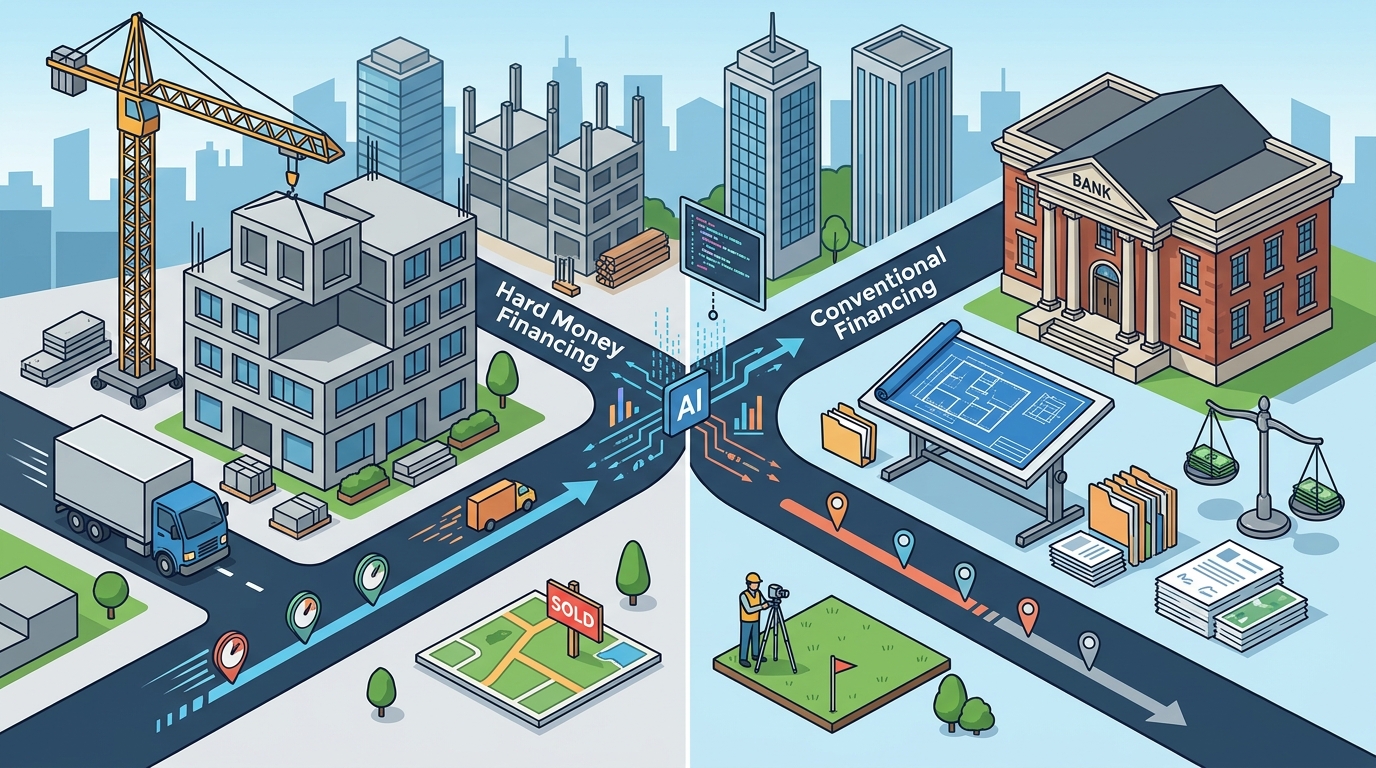
Securing capital for commercial real estate or undeveloped land requires navigating a complex landscape of private and institutional lenders. According to recent industry data, hard money loans for commercial properties often close in as little as 7 to 14 days, providing a critical speed advantage over traditional bank financing which can take 60 to 90 days. This rapid access to capital is essential for investors looking to secure properties at auction or execute time-sensitive fix-and-flip strategies. Understanding the distinct mechanics of these financing options is the first step toward building a profitable real estate portfolio. (Get Answers For Hard)
Understanding Commercial Loan Structures
Commercial real estate financing differs significantly from residential mortgages. Lenders evaluate the property's income-generating potential rather than just the borrower's personal credit score. This distinction opens doors for investors with strong assets but limited liquid income. The primary categories of capital available include conventional bank loans, private hard money loans, and specialized construction financing. (Loan Types In Los)
Hard money is a short-term loan secured by real estate. It is typically used by investors who need quick access to capital for acquisition or renovation. These loans are asset-based, meaning the value of the property is the primary factor in approval. This makes them ideal for properties that do not meet conventional lending standards, such as those requiring significant repairs or those located in niche markets.
Vacant land financing is another distinct category. Because land generates no immediate income, lenders view it as higher risk. Consequently, loan-to-value ratios are lower, and interest rates are higher. Investors must often provide a larger down payment, typically 20 to 50 percent of the land's appraised value. Understanding these structural differences is crucial for selecting the right capital source.
Hard Money Lenders for Commercial Projects
Hard money lenders provide the speed and flexibility that traditional banks cannot match. For commercial investors, this speed is often the difference between securing a deal and losing it to a competitor. These lenders focus on the "exit strategy" of the borrower. They want to know how the loan will be repaid, whether through refinancing into a conventional mortgage or the sale of the property.
The Multi-Lender Protocol utilized by platforms like Lendersa allows borrowers to present their commercial loan request to multiple qualified lenders simultaneously. This creates a competitive environment where lenders bid for your business, often resulting in more favorable terms. By pitting lenders against each other, you can secure lower interest rates or reduced origination fees.
Commercial hard money loans are versatile. They can be used for fix-and-flip projects, bridge loans, or even start-up construction. The flexibility extends to the loan structure itself. Borrowers can choose between interest-only payments, fully amortized schedules, or balloon payments. This adaptability allows investors to align their debt service with their cash flow projections.
Vacant Land Financing Options
Financing vacant land presents unique challenges. Lenders are cautious because the property has no collateral value in terms of income generation. If the borrower defaults, the lender is left with undeveloped land, which is harder to liquidate than a built structure. Therefore, the criteria for approval are stricter.
There are several types of land loans available. Raw land loans are for undeveloped property with no utilities or access. These carry the highest interest rates and lowest loan-to-value ratios. Improved land loans are for properties with basic utilities and road access. These are easier to finance and offer better terms. Construction-to-permanent loans are another option, allowing investors to finance both the land purchase and the building process in one package.
For investors with strong equity but poor credit, hard money lenders offer a viable alternative. These lenders prioritize the equity in the land over the borrower's financial history. This is particularly useful for investors who have experienced past financial difficulties but have a solid plan for the land's development. The focus remains on the property's potential rather than the borrower's past.
Conventional vs. Private Capital
Choosing between conventional bank loans and private capital depends on your timeline and property condition. Conventional loans offer lower interest rates and longer terms, making them cost-effective for long-term holds. However, they require strict documentation, including income verification, tax returns, and a high credit score. The underwriting process is rigorous and time-consuming.
Private capital, including hard money and bridge loans, offers speed and flexibility. These loans can close in days rather than months. They are ideal for investors who need to act quickly or who have properties that do not meet conventional standards. The trade-off is higher interest rates and shorter terms. Investors must have a clear exit strategy to refinance or sell the property before the loan matures.
The decision often comes down to the specific needs of the deal. For a quick flip, speed is paramount, making hard money the better choice. For a long-term rental property, the lower cost of conventional financing is more attractive. Lendersa helps borrowers navigate this decision by comparing offers from both banks and private investors, ensuring the best balance of cost and speed.
Financing Comparison Matrix
| Feature | Conventional Commercial Loan | Hard Money Loan | Vacant Land Loan |
|---|---|---|---|
| Closing Time | 60 to 90 days | 7 to 14 days | 30 to 60 days |
| Interest Rates | Lower (Market Dependent) | Higher (10-15%+) | Higher (12-18%+) |
| Loan-to-Value (LTV) | 65-75% | 60-70% | 50-80% |
| Credit Requirements | Strict (720+) | Flexible (Asset-Based) | Moderate to Strict |
| Best For | Long-term Holds | Fix-and-Flip / Bridge | Development Projects |
Key Takeaways
- Speed Advantage: Hard money loans can close in as little as 7 days, significantly faster than conventional bank financing.
- Asset-Based Approval: Lenders focus on the property's value and your exit strategy, not just your credit score.
- Vacant Land Risks: Undeveloped land requires larger down payments, often 20 to 50 percent, due to higher lender risk.
- Competitive Bidding: Using a platform like Lendersa allows lenders to compete for your business, potentially lowering rates.
- Exit Strategy Critical: Hard money loans are short-term; you must have a clear plan to refinance or sell the property.
- Flexibility: Private capital offers flexible terms, including interest-only payments, which can improve cash flow during renovations.
- Nationwide Reach: Capital is available across all 50 states, including specialized programs for commercial and vacant land.
Frequently Asked Questions
What is the minimum credit score for commercial hard money loans?
Hard money lenders are primarily asset-based. While they may check credit, a low score is often acceptable if the property has sufficient equity. The focus is on the loan-to-value ratio and the viability of the exit strategy.
Can I finance 100% of the cost for vacant land?
It is rare to finance 100% of vacant land. Most lenders require a down payment of 20 to 50 percent. This ensures the borrower has skin in the game and reduces the lender's risk.
How does the Multi-Lender Protocol work?
The Multi-Lender Protocol allows you to submit your loan details once. Our system then routes your request to multiple qualified lenders simultaneously. They compete to offer you the best terms, saving you time and money.
What is a bridge loan for commercial real estate?
A bridge loan is a short-term financing option used to "bridge" the gap between immediate capital needs and long-term financing. It is often used for properties that need renovation before they can qualify for a conventional mortgage.
Are there loans available for properties with bad credit?
Yes. Hard money lenders focus on the property's value rather than the borrower's credit history. If you have strong equity in the property, you may still qualify for funding despite a poor credit score.
How long does it take to get a commercial loan quote?
With traditional banks, the process can take weeks. With Lendersa's AI-driven platform, you can receive competitive offers from multiple lenders in minutes, allowing you to act quickly on investment opportunities.
What types of commercial properties can be financed?
Financing is available for a wide range of properties, including office buildings, retail spaces, industrial warehouses, and multi-family residential complexes. Vacant land for development is also eligible for specific loan products.
Get Your Competitive Offers
Stop searching for lenders one by one. Let our advanced AI do the heavy lifting. Start your loan application today to compare hard money and conventional loans instantly. No Social Security Number is needed to view initial offers. Secure the best terms for your commercial or vacant land project by letting lenders compete for your business.