

What to Look for When Comparing Hard Money Loan Term Sheets Side by Side
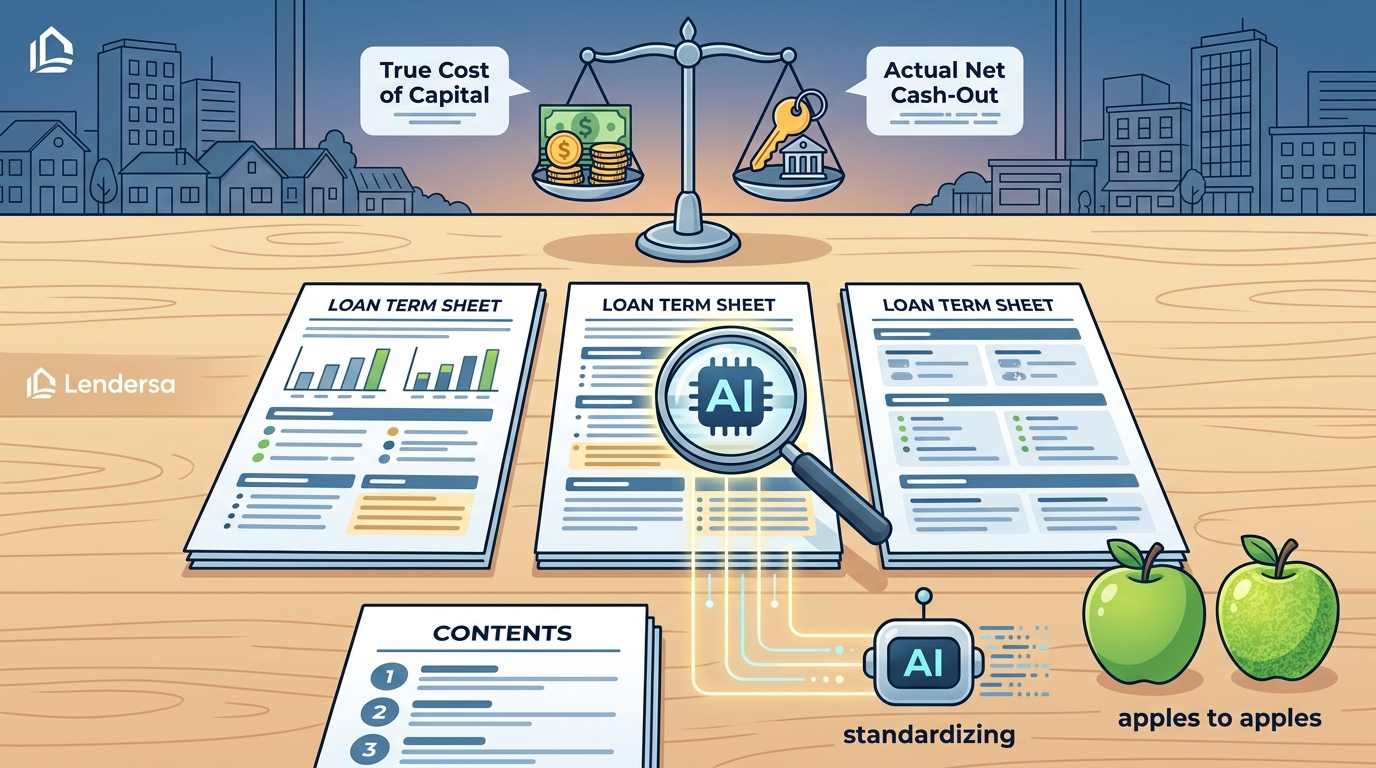
When comparing hard money loan term sheets side by side, you must evaluate the true cost of capital, not just the headline interest rate. Lendersa’s AI-powered platform standardizes these documents to reveal hidden fees, restrictive covenants, and the actual net cash-out. This approach ensures you are comparing apples to apples, allowing you to identify the most favorable terms for your specific real estate investment strategy.
The True Cost of Capital Beyond the Headline Rate
Many borrowers make the mistake of focusing exclusively on the stated interest rate when reviewing a term sheet. A hard money loan is a type of loan that is secured by real property, often characterized by higher rates to compensate for the lender's risk. However, the interest rate is only one component of the total cost. You must calculate the Annual Percentage Rate (APR), which includes all fees and points charged over the life of the loan. A lender offering a 9% rate with 4 points may be more expensive than a lender offering a 10% rate with 1 point. By standardizing these figures, you can see the true financial impact of each offer.
Identifying Hidden Fees and Restrictive Covenants
Term sheets often contain fine print that can significantly alter the value of the deal. Lendersa’s proprietary tools, such as LoanCompare, are designed to ingest these documents and flag non-obvious traps. You should look for predatory default interest rates, which can spike dramatically if you miss a payment. Additionally, check for late fee structures and assumption restrictions that might limit your ability to transfer the loan. These covenants are frequently missed by human brokers but are critical for your long-term flexibility. Identifying these details early prevents costly surprises during the closing process.
Understanding Loan-to-Value and Equity Requirements
The Loan-to-Value (LTV) ratio is the most critical factor in hard money underwriting. LTV is the ratio between the loan amount and the property value, and it determines how much equity you must bring to the table. Most hard money lenders lend up to 65% LTV, though some may go higher for fix-and-flip projects. When comparing term sheets, verify the LTV calculation method. Some lenders use the current value, while others use the After Repair Value (ARV). This distinction can change the maximum loan amount by tens of thousands of dollars. Ensuring you understand the LTV basis is essential for accurate cash-out projections.
Evaluating Speed and Funding Certainty
Speed is a primary advantage of hard money lending, but not all lenders deliver on their promises. A term sheet should clearly state the expected timeline from approval to funding. While some lenders promise 7-day closes, others may take weeks due to internal underwriting bottlenecks. You should also evaluate the certainty of funding. Does the lender have the capital ready to go, or are they relying on a secondary source? Direct lenders often have faster funding times, but they may have stricter guidelines. Comparing these operational details helps you choose a lender who can meet your project deadlines.
Using AI to Standardize and Compare Offers
Manual comparison of term sheets is time-consuming and prone to error. Lendersa uses advanced AI to transform static documents into structured data for instant side-by-side analysis. This technology strips away marketing jargon and presents the key metrics in a standardized format. You can upload a Loan Estimate, an LOI, or even a screenshot of a term sheet, and the system will extract the relevant data. This allows you to see the best possible terms across all your bids in one easy view. By leveraging this technology, you gain the leverage needed to negotiate better rates and fees.
Key Takeaways
- Always calculate the APR to understand the true cost of the loan, not just the interest rate.
- Scrutinize the fine print for default interest rates, late fees, and assumption restrictions.
- Verify the LTV calculation method, as it directly impacts your maximum loan amount.
- Assess the lender's funding speed and certainty to ensure they can meet your deadlines.
- Use AI-powered tools to standardize term sheets for accurate apples-to-apples comparisons.
- Remember that hard money loans are asset-based, so your property equity is the primary underwriting factor.
Frequently Asked Questions
What is the most important factor in a hard money loan term sheet?
The Loan-to-Value (LTV) ratio is the most important factor, as it determines the loan amount based on the property's equity.
How do I compare term sheets from different lenders?
You should standardize the data by calculating the APR and net cash-out for each offer to ensure an accurate comparison.
What are hidden fees in a hard money loan?
Hidden fees include origination points, processing fees, and extension fees that are not included in the headline interest rate.
Can I negotiate the terms in a hard money loan?
Yes, you can and should negotiate rates, fees, and covenants before closing, especially when you have multiple competing offers.
How long does it take to fund a hard money loan?
Funding typically takes 1 to 3 weeks, though some lenders can close in as little as 7 days depending on the complexity of the deal.
Do I need a good credit score for a hard money loan?
No, hard money loans are primarily based on the property's equity, so credit score has little to no effect on approval.