

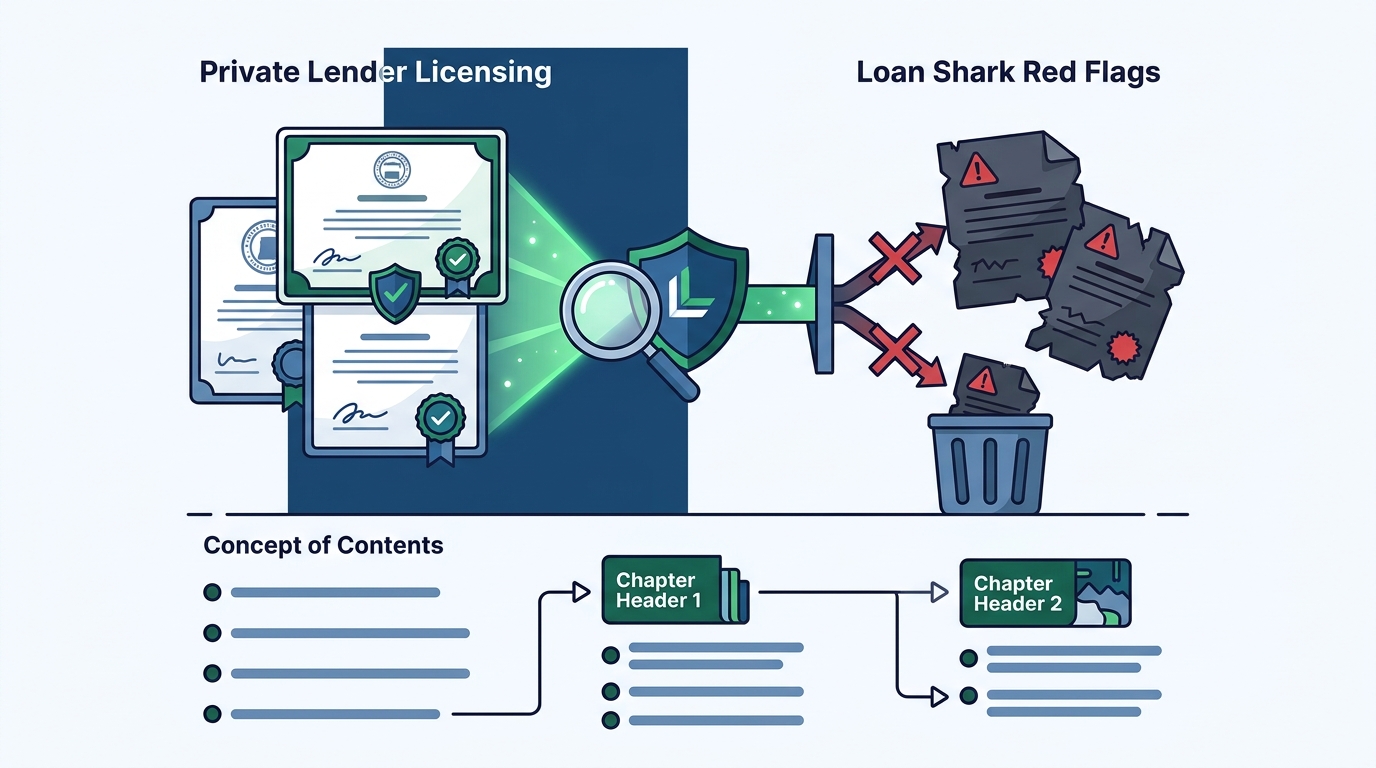
Legitimate private lenders hold active NMLS registrations and state-specific licenses, while loan sharks operate without legal authority. Lendersa verifies these credentials to ensure you only connect with licensed entities. This distinction protects your property and ensures legal recourse.
Legitimate Private Lender Licensing
A legitimate private lender is a registered entity that complies with federal and state lending regulations. The primary identifier is the Nationwide Multistate Licensing System (NMLS) number. This federal database tracks all licensed mortgage originators and lenders in the United States. If a lender cannot provide a valid NMLS ID, they are not legally authorized to originate most real estate secured loans.
State-Specific Requirements
Licensing is not uniform across the country. Each state has its own Department of Financial Institutions or equivalent regulatory body. For example, California requires lenders to hold a specific license from the Department of Business Oversight. Texas and Florida have their own distinct registration processes. A lender operating in multiple states must be licensed in each jurisdiction where they fund loans.
Corporate Structure and Transparency
Legitimate lenders operate as registered corporations or LLCs. They maintain physical office addresses and publish their ownership structure. They also adhere to the Truth in Lending Act (TILA), which mandates clear disclosure of interest rates, fees, and total costs. This transparency is a hallmark of a compliant private money lender.
Unlicensed Loan Shark Operations
A loan shark is an unlicensed individual or entity that lends money at illegally high interest rates. They do not appear in the NMLS database because they have never applied for or received a license. Their operations are often conducted through cash transactions, verbal agreements, or informal written notes that lack legal standing.
Lack of Regulatory Oversight
Unlicensed lenders operate outside the scope of consumer protection laws. They are not subject to usury caps, which are legal limits on interest rates. While a legitimate lender in most states cannot charge more than the statutory maximum, a loan shark can demand any rate they wish. This lack of oversight is the primary danger for borrowers.
Collection Practices
Because loan sharks are not bound by the Fair Debt Collection Practices Act, their collection methods can be aggressive and illegal. They may use intimidation, harassment, or threats to collect debts. Legitimate lenders, by contrast, must follow strict legal protocols for foreclosure and debt collection. If a lender suggests skipping legal channels to recover funds, it is a definitive red flag.
Comparison of Licensing and Compliance
| Criteria | Legitimate Private Lender | Unlicensed Loan Shark |
|---|---|---|
| NMLS Registration | Active and verifiable | None |
| State License | Held in all operating states | None |
| Interest Rate Limits | Subject to state usury caps | Unlimited and often predatory |
| Contract Documentation | Standard Deed of Trust with disclosures | Informal or missing legal documents |
| Collection Methods | Legal foreclosure and court processes | Intimidation and harassment |
| Physical Presence | Verifiable office and staff | Often anonymous or mobile |
How to Verify a Lender's License
Verification is a simple process that takes less than five minutes. You do not need to trust the lender's word. You must check the official government records. This step is non-negotiable for any borrower considering private financing.
Step 1: Check the NMLS Database
Visit the official NMLS Consumer Access website. Enter the lender's name or the individual's name. The system will display their license status, history, and any disciplinary actions. If the name does not appear, the lender is unlicensed. Lendersa integrates this verification to ensure all lenders on its platform are compliant.
Step 2: Verify State-Specific Licenses
NMLS shows federal registration, but you must also check the specific state where the property is located. For example, if you are buying in California, check the California Department of Business Oversight. If you are in Texas, check the Texas Department of Banking. A lender may be licensed in one state but not another. Ensure they are licensed in the state of the collateral.
Step 3: Review Disclosures
Legitimate lenders provide a Loan Estimate and a Closing Disclosure. These documents are standardized by the Consumer Financial Protection Bureau. If a lender refuses to provide these specific forms, they are likely operating illegally. The absence of these documents is a clear indicator of a loan shark.
Choose Legitimate Lenders If
Choose a legitimate private lender if you value legal protection and transparency. This is the right path if you are using the loan for a business purpose, a fix-and-flip project, or a bridge loan. Legitimate lenders offer clear terms, fixed rates, and legal recourse. They are the only safe option for long-term financial health.
Avoid Unlicensed Lenders If
Avoid unlicensed lenders if you are concerned about high interest rates or aggressive collection. If a lender asks for cash only, refuses to provide a written contract, or cannot show an NMLS number, walk away. The risk of losing your property to a loan shark far outweighs the convenience of quick funding. There is no legal protection for loans made by unlicensed entities.
Frequently Asked Questions
Can a loan shark sue me for repayment?
Yes, but the loan may be unenforceable. In many states, contracts with unlicensed lenders are void. However, the legal process is complex and costly. You may still face harassment. It is always better to avoid unlicensed lenders entirely.
Do I need a license to lend my own money to a friend?
Generally, no, if it is a one-time transaction. However, if you lend money repeatedly as a business, you need a license. Lendersa focuses on professional lending relationships where both parties are protected by standard contracts.
How do I report a loan shark?
Contact your state's Attorney General or Department of Financial Institutions. You can also report them to the NMLS. Providing details of the transaction and any communications will help authorities investigate. Lendersa encourages users to report any suspicious activity they encounter.
Is a hard money loan the same as a loan shark loan?
No. A hard money loan is a legitimate financial product offered by licensed lenders. It is secured by real estate and follows legal regulations. A loan shark loan is illegal and unregulated. The key difference is licensing and compliance with usury laws.
What if a legitimate lender raises my rate?
Legitimate lenders can adjust rates based on risk, but they must stay within legal limits. They must disclose the rate clearly in the contract. If a rate seems excessively high, ask for a breakdown of the risk factors. You can always compare offers on Lendersa to find a better rate.
Conclusion
Understanding the difference between a licensed private lender and a loan shark is essential for protecting your assets. Always verify NMLS registration and state licenses before signing any agreement. Lendersa provides a secure platform where all lenders are vetted for compliance. To find a licensed lender for your next project, visit Lendersa today.